
Introducing Scan: a 14-vector wellness engine for the dog in your living room
After two years of model development against 180+ peer-reviewed papers and 33,056 telehealth consultations, we're releasing a computer-vision wellness platform that turns a 60-second phone capture into a structured canine health assessment.

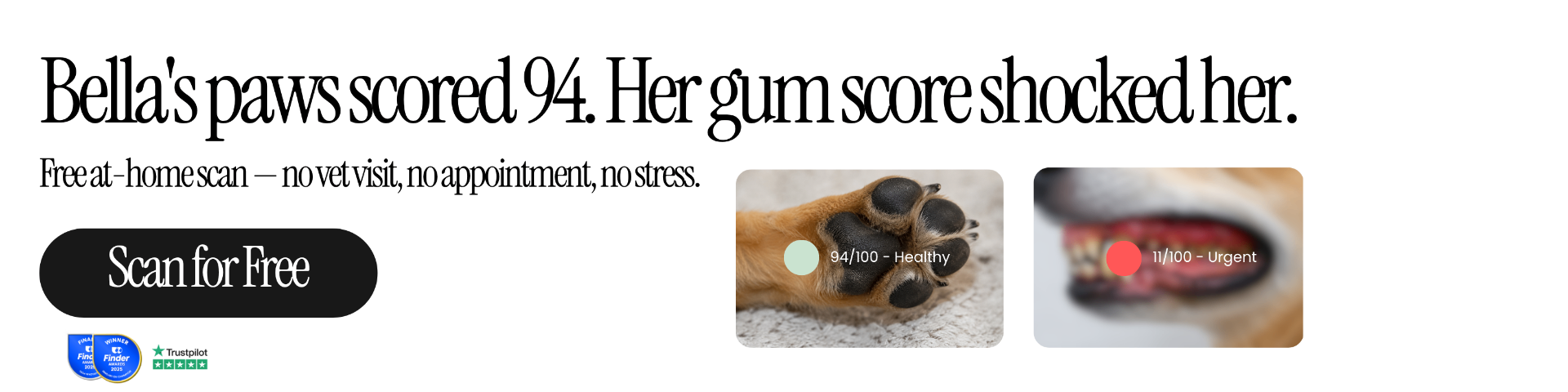
For the better part of a decade, Dial A Vet has sat in a privileged position: at the exact moment a worried owner first notices something is wrong with their dog. We have facilitated tens of thousands of consultations between owners and licensed veterinarians, and a pattern emerges with almost unsettling consistency. The conditions that escalate into expensive, painful, sometimes fatal outcomes are very rarely sudden. They are visible, often for weeks, in the eyes, the ears, the gums, the paw pads, the coat and the body condition of the animal. The problem was never that the signs weren't there. The problem was that nobody was trained to read them at home, and the disease had a head start by the time a vet was involved.
Today we are releasing Scan, a computer-vision wellness engine that reads those signs from an ordinary smartphone photograph and returns a structured, 14-vector assessment of your dog's preventative health. It is the most significant product we have ever shipped, and it represents a deliberate attempt to move the entire category from reactive to preventative medicine.
Why we built a wellness engine instead of another chatbot
The temptation in 2026 is to wrap a large language model in a friendly interface and call it veterinary AI. We rejected that approach early. Language models are extraordinary at restating what is already known; they are not measurement instruments. Owners do not need a more articulate description of their anxiety, they need an objective read on the animal in front of them. So we built Scan as a measurement system first and a communication layer second.
At the core of Scan is a multimodal vision pipeline that segments the regions of clinical interest in a photo, scores each against published disease signatures, and maps those scores into 14 wellness vectors. These vectors span ocular health, otic health, periodontal and gingival condition, paw-pad and claw integrity, coat and dermatological markers, body condition, and an estimate of wellness age benchmarked against breed-specific lifespan curves. Each vector is grounded in peer-reviewed literature, and each result is expressed with an explicit confidence level rather than a false sense of certainty.
Scan's model is referenced against 180+ peer-reviewed veterinary papers and tuned on 33,056 of Dial A Vet's top consultations. It assesses 14 distinct wellness vectors from imagery and a short owner questionnaire — as an at-home visual screening tool, not a diagnostic device.
The clinical foundation: 180+ papers, not a hunch
Every vector in Scan traces back to published clinical research. Our ophthalmic scoring draws on deep-learning detection of canine ocular disease and on large UK first-opinion prevalence studies of conjunctival and corneal pathology. Our otic vector is built on multicentre case-control work into otitis externa and on microbial studies of the external ear canal. Periodontal scoring leans on prevalence data showing that periodontal disease is the single most common condition in adult dogs, and on research linking gingival inflammation to systemic morbidity. We did not invent these relationships, we operationalised them.
The same discipline applies to our most ambitious vector: wellness age. Epigenetic clocks derived from the canine DNA methylome have shown that dogs age along a non-linear, breed-influenced trajectory. Scan does not claim to read methylation from a photograph, that would be pseudoscience. Instead, it estimates a wellness-age band from observable proxies (coat condition, ocular clarity, body condition, dental wear) and calibrates that band against the published ageing literature, always presented alongside chronological age and breed lifespan data.
“We are not trying to replace your veterinarian. We are trying to make sure that by the time you reach them, you are early, not late.”
33,056 consultations taught us what owners actually miss
A model is only as honest as the data that disciplines it. Beyond the published literature, Scan is tuned against 33,056 of Dial A Vet's highest-signal consultations, anonymised, owner-presented cases covering exactly the regions vets are asked about most. This proprietary dataset does something the academic literature alone cannot: it captures the gap between what is clinically visible and what owners report noticing. That gap is where preventative medicine lives, and closing it is the entire point of Scan.
A 60-second look at your pet's health.
Eyes, ears, gums and paw pads — an at-home visual wellness screening from a single photo. Spot issues early, before they become expensive ones.
Scan Your Dog→It also taught us humility about photographs. Skin and allergy signs, for example, are routinely fabricated by naïve models from a single whole-dog photo because the model 'expects' to find something. We re-engineered Scan so that the skin and allergy vector is only scored when an owner submits a dedicated belly and inner-thigh close-up, the thin-haired regions where allergic skin disease genuinely shows. No belly photo, no score. The vector is honestly marked 'not assessed' rather than invented. That decision cost us a tidier-looking report and bought us something far more valuable: trust.
How a Scan works in practice
- Capture: the owner photographs their dog and, optionally, close-ups of the eyes, ears, gums, paws and belly under the in-app guidance.
- Segment: the vision pipeline isolates each region of clinical interest and rejects unusable frames.
- Score: each region is scored against published disease signatures and mapped to the relevant wellness vectors.
- Benchmark: results are calibrated against breed, age and the Dial A Vet consultation dataset.
- Report: the owner receives a structured 14-vector report with confidence levels, risk flags, monitoring guidance and a clear escalation path to a licensed vet.
What Scan is, and what it is deliberately not
Scan is a preventative wellness instrument. It is not a medical device, it does not diagnose, and it never will pretend to. Every report carries an explicit statement to that effect, and every result that crosses a severity threshold routes the owner toward a real consultation with a licensed veterinarian, frequently one of ours. We see Scan as the top of a funnel of care, not a replacement for the clinician at the bottom of it. The economics of preventative medicine only work when early detection feeds into timely professional treatment, and that handoff is engineered into the product, not bolted on.
We have also made privacy non-negotiable. Photos are processed privately and are never used to train our models without explicit, separate consent. The asymmetry of trust between an owner and a company holding images of their family pet is not something we take lightly.
Where we go from here
This launch is a foundation, not a finish line. Over the coming months we will expand longitudinal tracking, so that Scan compares your dog against your dog over time, which is clinically far more powerful than any single snapshot. We will deepen breed-specific calibration, extend the vision pipeline to additional regions, and continue to publish the research that underpins every claim we make. Our standard is simple and uncompromising: if we cannot cite it, we will not score it.
Preventative care has always been the most cost-effective, least painful, longest-lifespan path for companion animals. The barrier was never the medicine, it was access and timing. Scan exists to dissolve both. Point your phone at the dog you love, and let the science do the reading.
A 60-second look at your pet's health.
Eyes, ears, gums and paw pads — an at-home visual wellness screening from a single photo. Spot issues early, before they become expensive ones.
Scan Your Dog→Building Scan — the preventative canine wellness engine — referenced against 180+ peer-reviewed veterinary papers and tuned on 33,056 telehealth consultations.